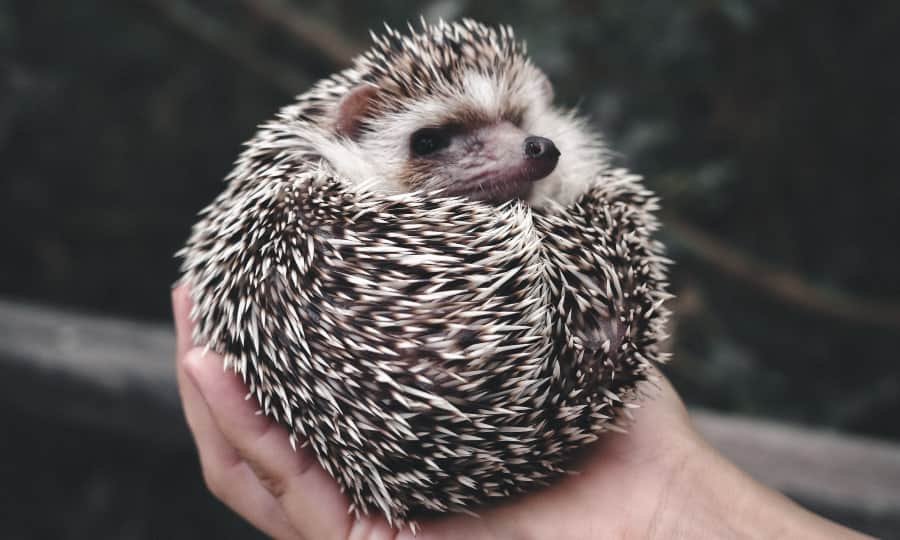
Many first-time hedgehog owners make the same mistake the moment they see their pet curl into a tight little ball. From a human perspective, the reaction often looks almost cute, even comforting. Because the hedgehog appears tucked in, still, and protected, many people instinctively assume that this means the animal feels safe, calm, or simply wants to rest. Some even see it as a sign that the hedgehog is getting comfortable in their hands.
But in reality, that assumption can be deeply misleading.
A hedgehog turning into a ball is usually not a sign that it feels relaxed or secure. In most cases, it means exactly the opposite. This behavior is one of the clearest defensive signals the animal can give, and the hidden message behind it is much more direct than many owners realize.
It means stop.
Stop touching.
Stop moving closer.
Stop creating more stimulation.
Stop doing whatever is currently making the animal feel threatened.
This is one of the most important mindset shifts in understanding hedgehog behavior because what looks adorable to a human is often actually a very clear boundary signal from the animal itself.
A hedgehog does not curl into a ball because it is trying to look comfortable. It curls into a ball because it is trying to protect itself. This is a deeply instinctive defense mechanism built into its survival behavior. In the wild, when a hedgehog senses danger, unfamiliar movement, sudden sound, or unwanted contact, curling into a ball becomes one of its strongest protective responses. By pulling its body inward and exposing its quills outward, it creates a barrier designed to discourage predators and reduce vulnerability.
This means the behavior should never be read as emotional comfort.
It is usually a sign of discomfort, fear, uncertainty, or overstimulation.
Many owners unintentionally make the situation worse by continuing the interaction at that exact moment. Because the hedgehog is not actively running away, some people assume it is acceptable to keep touching it, pick it up again, or continue trying to “help it relax.” But from the hedgehog’s perspective, the ball posture is already the communication.
It is the clearest possible no.
The problem is that people often misread stillness as acceptance.
With hedgehogs, stillness in this form often means self-protection.
Why This Happens More Than Owners Realize
This behavior can be triggered by many things, and sometimes the cause is much smaller than owners expect. Hedgehogs are highly sensitive to their environment and react strongly to changes that humans may barely notice.
A new scent on your hands.
A loud sound in the room.
A bright light.
A sudden movement.
A change in temperature.
Being woken up unexpectedly.
Even something as simple as picking the hedgehog up too quickly can be enough to trigger a defensive curl.
This is why the behavior often feels sudden to the owner.
From the human perspective, “nothing happened.”
From the hedgehog’s perspective, something absolutely did.
This is why observation matters so much.
The real question is not just why did it curl up?
The better question is what happened right before it curled up?
Once you start asking that, the pattern often becomes much easier to identify.
The Hidden Meaning Behind the Ball
The ball is not just a posture.
It is communication.
This is one of the most important things to understand.
Your hedgehog is telling you that the current level of interaction feels unsafe or overwhelming.
It is not random.
It is not moodiness.
It is a protective response.
The hidden mistake many owners make is assuming they need to “push through” the behavior so the pet gets used to them faster.
In reality, repeatedly ignoring this signal can slow down trust-building.
If every time the hedgehog curls up the interaction continues anyway, the animal may start associating handling with stress.
Over time, this can make the defensive response stronger and more frequent.
This is why respecting the signal is so important.
Trust is built when the animal learns that its boundaries are understood.
The Bigger Perspective Shift
The biggest shift is understanding that defensive behavior is still communication.
Your hedgehog is not being difficult.
It is responding exactly as its instincts tell it to.
Once you stop seeing the ball as a cute resting pose and start seeing it as a message, the interaction becomes much clearer.
The message is simple:
I need space.
I need less stimulation.
I do not feel safe right now.
That understanding changes everything.
Instead of forcing interaction, you begin adjusting the environment.
Slower movement.
Softer handling.
Less noise.
More predictability.
That is what helps the hedgehog feel safer over time.
Conclusion
When your hedgehog turns into a ball, it usually does not mean it feels safe.
It usually means the opposite.
This posture is one of the clearest defensive signals the animal can give, and the message behind it is simple: stop.
Stop the current interaction.
Pause.
Observe what triggered it.
Respect the boundary.
Once you begin reading the behavior as communication instead of comfort, the relationship becomes much easier to build.
The fastest way to create trust is not forcing more contact.
It is understanding what the animal is already trying to tell you.
Sometimes the strongest bond starts when you learn when to stop.

David Bencivenga
Writer, advertising copywriter and SEO analyst, I am originally from New York and have been passionate about reading and writing since I was little. Books have always been my companions and favorite pastime, which led me to my profession. I hope you enjoy each of my texts and that they can help you in some way. Happy reading!