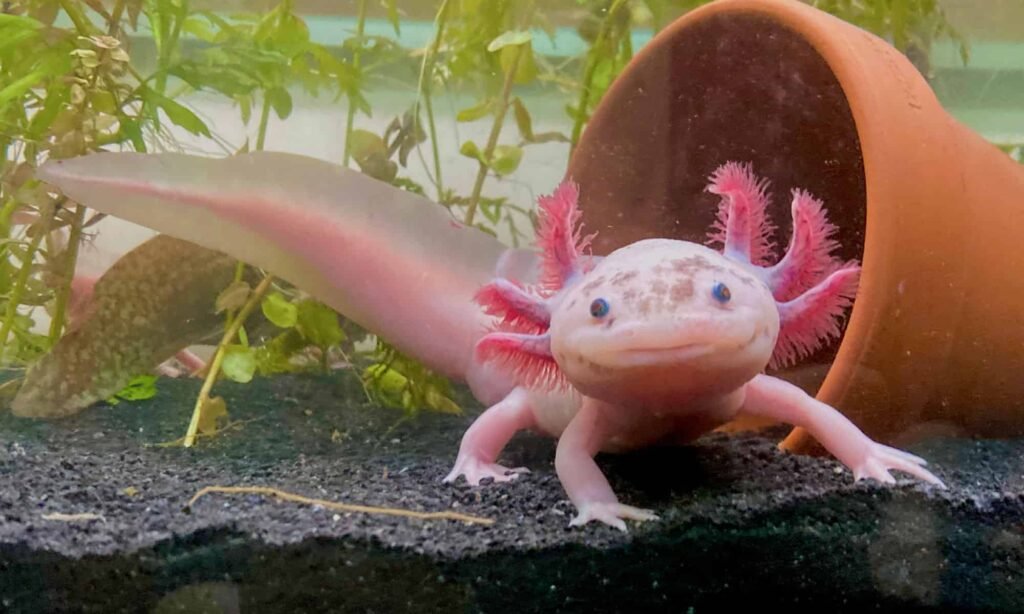
Many first-time axolotl owners become worried the moment they notice how little their pet seems to move. Compared to fish that swim constantly across the tank, explore decorations, or remain active throughout the day, an axolotl can appear almost completely still for long periods. It may rest at the bottom of the tank, stay in the same corner for hours, or only make very subtle movements with its body and gills. To someone unfamiliar with the species, this can immediately feel like something is wrong.
The first reaction is usually concern.
People often assume the axolotl is sick, tired, stressed, or unhappy with the tank conditions.
But in many cases, that assumption is completely wrong.
What looks like a problem is often a sign that the axolotl is behaving exactly as nature designed it to.
The truth is that an axolotl’s stillness is usually not a sign of weakness.
It is a sign of efficiency.
Once you understand how this animal naturally lives and conserves energy, the behavior starts to make much more sense.
Why Axolotls Naturally Move So Little
One of the biggest mistakes new owners make is comparing an axolotl to fish.
Even though they live in water, axolotls do not behave like typical aquarium fish.
They are built very differently.
Their body, instincts, and natural survival strategies are based around conserving energy rather than constant movement.
In their natural behavior, axolotls are not animals that spend the entire day swimming around the environment.
Instead, they often remain still, observe what is happening around them, and only move when there is a reason to.
That reason is usually food, a disturbance in the environment, or a change in comfort.
This low-movement pattern is actually extremely efficient.
Instead of wasting energy swimming continuously, the axolotl preserves its energy and uses it only when necessary.
This is part of what makes the species so fascinating.
What many owners call “lazy” is actually an incredibly smart biological strategy.
Stillness helps reduce unnecessary energy expenditure.
In simple terms, your axolotl is not doing less because something is wrong.
It is doing less because its body is designed to do exactly that.
Why Stillness Often Means Comfort
Another important detail many owners never realize is that stillness can often be a sign of comfort rather than distress.
Animals that feel threatened or stressed often show excessive movement, attempts to escape, frantic swimming, or constant hiding.
An axolotl that remains calmly in one area of the tank is often showing the opposite.
It means the environment feels safe.
The water temperature is stable.
The lighting is not too harsh.
The tank layout feels comfortable.
There is no immediate need to move.
This is why stillness can actually be reassuring.
A comfortable axolotl has no reason to waste energy moving constantly.
It stays where it feels secure.
Many owners assume pets need to look active all the time in order to be healthy.
That assumption comes from comparing them to other animals.
Axolotls follow a completely different logic.
Their calm behavior is often a sign that they feel settled.
The Real Reason: Energy Efficiency
The deeper reason behind this behavior comes down to efficiency.
Axolotls are masters at energy conservation.
Their body is not designed for speed or endless movement.
Instead, it is designed for strategic movement.
When food is present, they respond.
When something changes in the environment, they respond.
When they want to reposition themselves, they move.
Outside of that, remaining still is the most efficient use of energy.
This becomes even more important when you understand how animals survive in nature.
Every movement costs energy.
For many species, unnecessary movement means unnecessary calorie loss.
The axolotl’s instinct is to avoid that.
This is why the stillness should not automatically be seen as inactivity.
It is purposeful.
It is biological efficiency in action.
Why the Gills and Small Movements Matter More
Instead of focusing on how often the axolotl moves around the tank, it is much more useful to observe smaller signs.
Look at the gills.
Look at breathing rhythm.
Look at how it responds when food is introduced.
Look at whether it changes resting positions throughout the day.
These details tell you much more than constant swimming ever would.
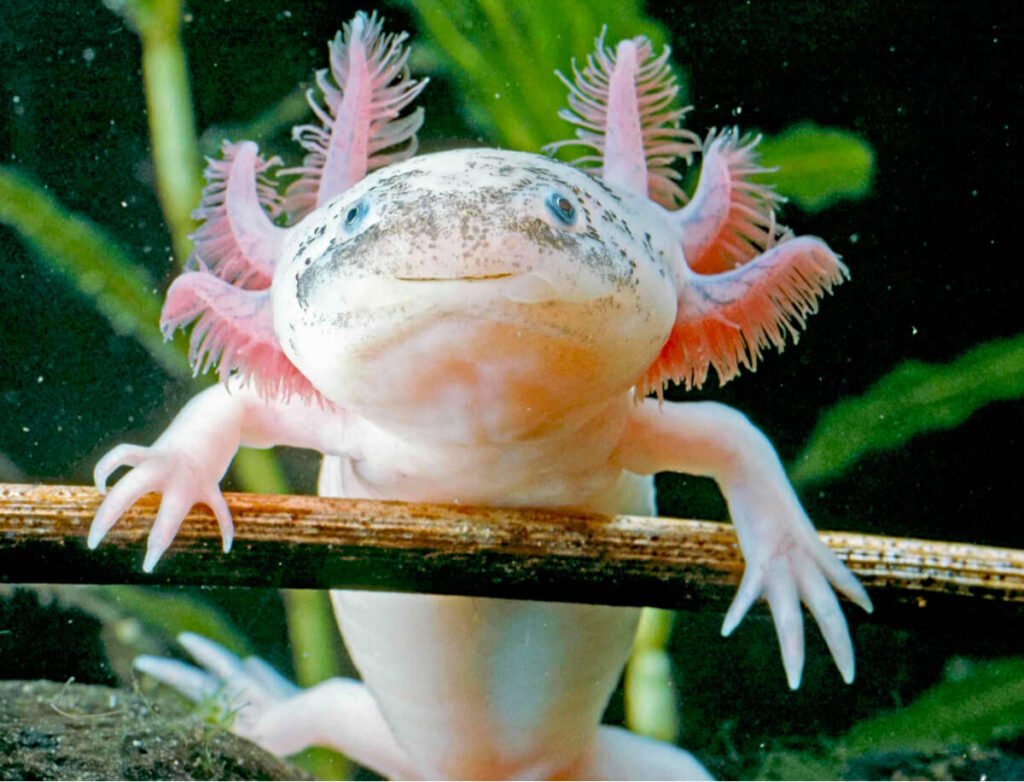
A healthy axolotl may stay in the same area for a long time, but its gills should still show normal subtle movement.
Its body posture should look relaxed.
When food appears, it should become noticeably more responsive.
These are stronger indicators of health than overall movement frequency.
The quality of movement matters far more than the amount.
When Stillness Can Actually Be a Problem
While stillness is often normal, context always matters.
The key is to look for other warning signs.
If your axolotl barely moves but still eats well, reacts to feeding, maintains healthy gills, and appears comfortable, this behavior is usually completely normal.
However, concern becomes more reasonable if the stillness is accompanied by other symptoms.
For example, signs such as loss of appetite, curled gills, unusual floating, pale coloration, or visible stress in posture may indicate that the issue is not simple energy conservation.
Water quality can also play a major role.
Poor water parameters, incorrect temperature, and excessive light can all affect behavior.
This is why stillness alone should never be judged in isolation.
The full picture matters.
The Perspective Shift That Changes Everything
The biggest mindset shift is understanding that movement does not equal health.
For an axolotl, stillness is often part of healthy, normal behavior.
What seems unusual to us is often completely natural for the species.
Once you stop comparing it to constantly active fish, the behavior starts to make sense.
Your axolotl is not supposed to be in motion all day.
It is supposed to conserve energy and move only when needed.
That is not laziness.
That is efficiency.
And in many cases, it is actually a sign that your pet feels comfortable, safe, and biologically normal.
Conclusion
If your axolotl barely moves, that is often not a problem at all.
In fact, it can be a very good sign.
Stillness in axolotls is usually a reflection of their natural instinct to conserve energy and remain efficient.
Rather than judging health by constant movement, focus on breathing, gill condition, appetite, and smooth response to food.
Sometimes the healthiest behavior does not look active.
Sometimes it looks calm.
And for an axolotl, calm is often exactly what you want to see.

David Bencivenga
Writer, advertising copywriter and SEO analyst, I am originally from New York and have been passionate about reading and writing since I was little. Books have always been my companions and favorite pastime, which led me to my profession. I hope you enjoy each of my texts and that they can help you in some way. Happy reading!