
Introduction
Ferrets have a reputation.
Playful. Energetic. Curious.
But also:
👉 they bite
And for many owners, that becomes a problem very quickly.
You try to interact…
The ferret engages…
Then suddenly, it bites harder than expected.
Not enough to seriously injure.
But enough to make you pull away.
So the reaction is immediate:
👉 “It’s being aggressive.”
But in most cases, that interpretation is wrong.
Because what feels like aggression…
👉 is often play that hasn’t been calibrated
Why This Matters
If you treat play-biting as aggression, you respond incorrectly.
You might:
- pull your hand away abruptly
- react emotionally
- stop interaction completely
- punish the behavior
These reactions don’t solve the issue.
In fact, they often make it worse.
Because the ferret is not trying to harm you.
👉 it is trying to interact
How Ferrets Actually Play
Ferrets don’t play gently with each other.
Their natural play includes:
- chasing
- tackling
- biting
- rolling
But there’s an important detail:
👉 both sides understand the limits
They adjust pressure constantly.
This is called:
👉 bite inhibition
And it develops through interaction with other ferrets.
The Human Problem
When a ferret interacts with a human, something changes.
You don’t:
- respond the same way
- move the same way
- communicate limits the same way
So the ferret continues using:
👉 its natural intensity
Without realizing it’s too much.
A Practical Example
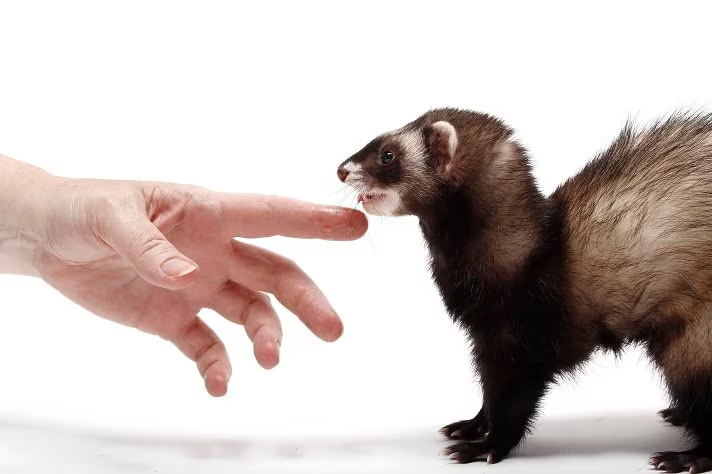
A ferret grabs your hand and bites.
From your perspective:
👉 pain
From the ferret’s perspective:
👉 engagement
You pull away quickly.
Now the ferret learns something new:
👉 fast movement = more stimulation
So next time, it bites again.
Harder.
Why Pulling Away Reinforces the Behavior
Quick withdrawal creates a chase response.
To the ferret, your hand becomes:
👉 a moving target
This increases excitement.
Not control.
The Missing Calibration
Young ferrets learn limits by:
- receiving feedback
- adjusting pressure
- repeating interaction
If that feedback is unclear or inconsistent…
👉 the calibration never develops
So the ferret doesn’t know:
👉 how hard is too hard
Step-by-Step Behavior Adjustment
Step 1: Stay Controlled
Avoid exaggerated reactions.
Sudden movement increases stimulation.
Step 2: Pause Interaction
If the bite is too strong:
👉 stop engagement calmly
No reaction.
No sudden movement.
Step 3: Resume When Calm
Return to interaction when intensity drops.
This creates contrast.
Step 4: Use Consistent Feedback
A clear, repeated response helps the ferret adjust pressure over time.
Common Misinterpretations
“It’s aggressive”
Most play-biting is not aggression.
“It’s trying to dominate”
This is not a dominance behavior.
“It will always be like this”
With proper feedback, intensity can decrease significantly.

Special Cases
Some ferrets:
- were separated early
- lacked social interaction
- were handled inconsistently
These may require more time to adjust.
The Bigger Shift
The goal is not to stop play.
It is to:
👉 shape intensity
Because play is natural.
But uncontrolled intensity creates problems.
The Perspective Change
Instead of asking:
👉 “How do I stop the biting?”
Ask:
👉 “How do I teach the right level of pressure?”
Because the behavior itself is not wrong.
👉 the intensity is
Conclusion
Your ferret is not trying to hurt you.
It is playing the only way it knows.
Without proper feedback, it doesn’t adjust.
Once interaction becomes:
- consistent
- controlled
- clear
The biting changes.
Not because play stopped.
👉 but because it became calibrated
And when calibration happens…
👉 play becomes safe, not painful.