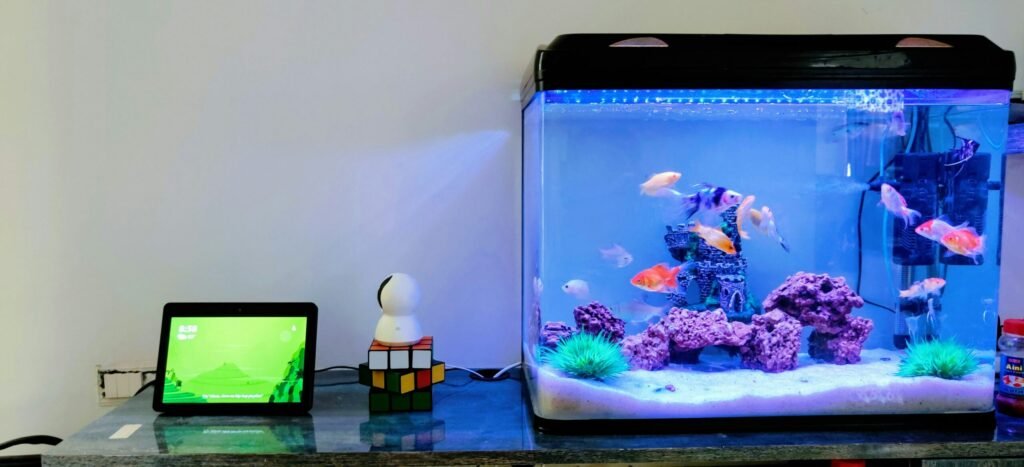
Many aquarium owners make the same assumption the moment they look at their tank and see crystal-clear water. The glass looks spotless, the decorations are visible from every angle, and there are no obvious signs of dirt floating around. At first glance, everything seems perfectly fine. In fact, many people use visual clarity as their main way of deciding whether the aquarium is healthy.
If the water looks clean, the tank must be doing well.
That assumption feels logical.
Unfortunately, it is also one of the most common reasons hidden tank problems go unnoticed for far too long.
The truth is that a fish tank can look almost perfect on the outside while still having serious invisible issues developing beneath the surface. Unlike what many beginners believe, water clarity and water quality are not the same thing. A tank can appear clear and still contain harmful compounds that place fish under constant stress. Some of the most dangerous aquarium problems cannot be seen with the human eye at all.
This is what makes the issue so deceptive.
By the time visible symptoms begin to appear, the fish may already be dealing with poor conditions that have been building quietly for days or even weeks.
What you are not seeing is often far more important than what you are.
Why Clear Water Can Be Misleading
One of the biggest misconceptions in fishkeeping is the idea that clean-looking water automatically means healthy water. Clear water only tells you one thing: there are no visible particles significantly affecting how light passes through the tank. That is a visual observation, not a biological one.
Many of the real threats inside an aquarium are chemical and microbial.
These do not make the water cloudy.
They do not always create a smell.
They do not necessarily change the color of the water.
This is why a tank can appear visually perfect while still causing ongoing problems for the fish inside it.
Ammonia is one of the clearest examples of this.
Fish waste, uneaten food, and decomposing organic matter all release ammonia into the water. Ammonia is highly toxic even in small amounts, yet it is completely invisible. You cannot look at a tank and know ammonia levels by sight. The same applies to nitrites, which are another dangerous compound that often appears during cycling issues or filter instability.
This is where many owners become confused.
They see clear water and assume the tank is stable.
Meanwhile, the fish may be swimming in conditions that are chemically stressful.
The problem is not what the eye sees.
The problem is what the water chemistry is doing.
The Hidden Problems Most Owners Never Notice
One of the biggest invisible issues is poor nitrogen cycle balance.
A healthy tank depends on beneficial bacteria that convert toxic ammonia into nitrites and then into nitrates. This biological filtration process is what keeps the environment safe over time.
When something disrupts that cycle, the tank may still look beautiful.
The water may remain clear.
But the biological balance may be collapsing.
This often happens after:
- overcleaning the filter
- changing too much water at once
- replacing filter media completely
- adding too many fish too quickly
- overfeeding
None of these problems necessarily change the way the water looks right away.
But chemically, they can create a dangerous environment.
Another invisible issue is low oxygenation.
Some tanks appear visually perfect but have poor water movement or insufficient surface agitation. Fish may begin to show signs of stress even though nothing seems wrong to the owner. Again, this is not a visual issue. It is an environmental one.
pH instability is another common hidden problem.
Water can remain crystal clear while the pH slowly drifts into a range that stresses the fish.
Because many species are sensitive to changes in water parameters, even small fluctuations can affect health over time.
Why Fish Often Show the Problem Before the Tank Does
One of the most important perspective shifts in aquarium care is learning that fish behavior often reveals problems before the tank visually does.
The fish are usually the first indicator.
Long before water looks dirty, fish may begin to show subtle warning signs.
These can include slower movement, staying near the surface, clamped fins, reduced appetite, unusual hiding, or faster gill movement.
Many owners ignore these signs because the tank still looks clean.
This is where the visual trap becomes dangerous.
The eye says everything is fine.
The fish are telling a different story.
Behavior often reveals invisible chemistry problems long before the water itself shows any obvious sign.
What You’re Really Not Seeing
The most important thing you are not seeing is stress.
Fish live inside the water.
Every chemical imbalance directly affects them.
Unlike humans, they cannot step away from the environment.
They are fully immersed in it every second.
This means invisible issues create constant exposure.
A tank that looks perfect but contains unstable parameters can quietly create chronic stress.
Over time, this weakens the immune system.
This makes fish more vulnerable to disease, fungal infections, parasites, and shortened lifespan.
This is why “clean-looking” should never be your only standard.
The invisible health of the tank matters more than the visible clarity.
The Bigger Shift
The biggest mindset shift is understanding that visual cleanliness and biological health are two different things.
Clear water is only surface-level information.
True tank health comes from:
- stable ammonia and nitrite at zero
- controlled nitrate levels
- healthy filtration bacteria
- proper oxygenation
- stable temperature
- consistent pH
Once you start thinking in terms of water parameters rather than appearance, aquarium care becomes much more accurate.
Conclusion
Your fish tank can absolutely look clean and still be causing problems.
Some of the most dangerous issues in an aquarium are completely invisible to the eye.
Ammonia, nitrites, poor oxygenation, unstable pH, and biological imbalance do not need cloudy water to exist.
That is why fish behavior and water testing matter far more than visual clarity alone.
Sometimes the most dangerous tank is not the one that looks dirty.
It is the one that looks perfect while hidden problems continue building underneath.

David Bencivenga
Writer, advertising copywriter and SEO analyst, I am originally from New York and have been passionate about reading and writing since I was little. Books have always been my companions and favorite pastime, which led me to my profession. I hope you enjoy each of my texts and that they can help you in some way. Happy reading!