At first, many turtle owners look at their pet’s movement and immediately wonder if something is wrong. Compared to dogs that run to the door, cats that leap onto furniture, or even smaller pets that move with sudden bursts of speed, a turtle’s pace can seem almost surprisingly slow. It takes its time crossing the enclosure, pauses frequently, and often appears to move with a level of calm that humans sometimes interpret as weakness, tiredness, or even laziness. The truth is that this assumption usually comes from comparing the turtle to animals with completely different biology, instincts, and movement needs.
A turtle is not slow because it is failing to be active.
It is slow because its body is designed for efficiency, conservation, and controlled movement.
What many first-time owners mistake as low energy is often one of the most natural expressions of healthy turtle behavior. In fact, that slower pace is deeply connected to how turtles regulate energy use, body stress, and long-term survival. Unlike mammals that rely on constant internal heat production and fast metabolic cycles, turtles operate through a very different system. Their bodies are built to preserve resources, reduce unnecessary energy loss, and move only as much as needed.
This is exactly why slow movement is not a problem.
For many turtles, it is one of the strongest signs that the body is functioning the way nature intended.
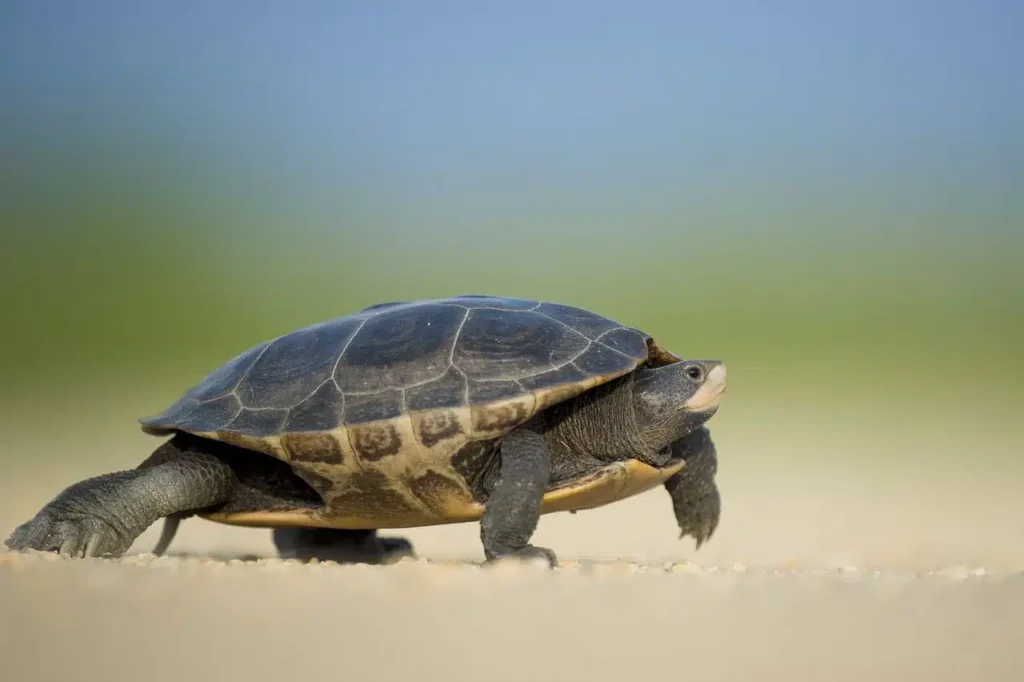
Why Slow Movement Is Part of Turtle Biology
One of the most important things to understand is that turtles are reptiles, and reptiles use energy very differently from mammals. Their metabolism is naturally slower, which means their body does not demand constant movement, frequent bursts of speed, or high levels of physical output in the same way a dog or cat might.
This slower metabolic rhythm affects everything.
Movement.
Digestion.
Feeding intervals.
Rest cycles.
Temperature regulation.
Because of this, the turtle’s body is naturally built around efficiency. Every movement tends to be deliberate rather than impulsive. Instead of wasting energy through constant motion, the turtle conserves it, using movement when there is a biological reason such as reaching heat, food, water, shelter, or a preferred resting area.
This is why many healthy turtles appear calm and measured.
They are not moving less because something is wrong.
They are moving according to the pace their body was designed for.
Why Fast Movement Would Actually Be More Concerning
One perspective shift that helps many owners is understanding that unusually frantic or restless movement can often be more concerning than normal slow pacing. A turtle that suddenly begins moving rapidly around the enclosure, repeatedly scratching glass, or showing constant restless motion may actually be signaling stress, environmental discomfort, or an unmet need.
By contrast, slow, controlled movement often reflects stability.
A healthy turtle tends to move with purpose.
It may slowly approach food.
Move toward the basking area.
Enter the water.
Change position to regulate temperature.
These movements are often calm because the body is not built for unnecessary urgency.
This is exactly what helps preserve long-term health.
Why Energy Conservation Supports Health
One of the biggest reasons turtles live with such measured movement patterns is because energy conservation supports survival. In nature, unnecessary movement can increase exposure, waste resources, and raise physical stress. Turtles evolved around minimizing that loss.
This affects not only physical movement but overall body regulation. A slower-moving turtle often places less mechanical stress on the body, uses energy more efficiently, and remains aligned with its metabolic rhythm.
From a health perspective, this efficiency matters.
The body is not constantly overexerting itself.
Instead, it is preserving balance.
This is one of the reasons slow, natural movement often aligns with healthy reptile function.
Why Human Comparison Creates Confusion
Many owners become worried because they compare the turtle to mammals or more active pets. Human minds naturally associate speed with vitality and slowness with weakness.
But for turtles, this comparison creates the wrong standard.
The correct comparison is not against mammals.
It is against normal species behavior.
When viewed through reptile biology, the slower pace often becomes reassuring rather than alarming.
The Bigger Perspective Shift
The most important shift is understanding that turtles are not supposed to move like faster companion animals. Their health is not measured by speed.
It is measured by consistency, posture, appetite, shell condition, and natural movement patterns.
Slow movement is often exactly what healthy turtle behavior looks like.
Conclusion
Your turtle moves slowly not because it is weak, tired, or unhealthy, but because its body is designed for deliberate and efficient movement.
That pace helps preserve energy, reduce stress, and support long-term biological balance.
Sometimes the healthiest thing about your turtle is the exact thing that first made you worry.
Its slowness is not a flaw.
It is one of the clearest signs that its body is doing exactly what it was built to do.

David Bencivenga
Writer, advertising copywriter and SEO analyst, I am originally from New York and have been passionate about reading and writing since I was little. Books have always been my companions and favorite pastime, which led me to my profession. I hope you enjoy each of my texts and that they can help you in some way. Happy reading!